What Did the Gnostics Mean When They Said the World Was a Mistake?
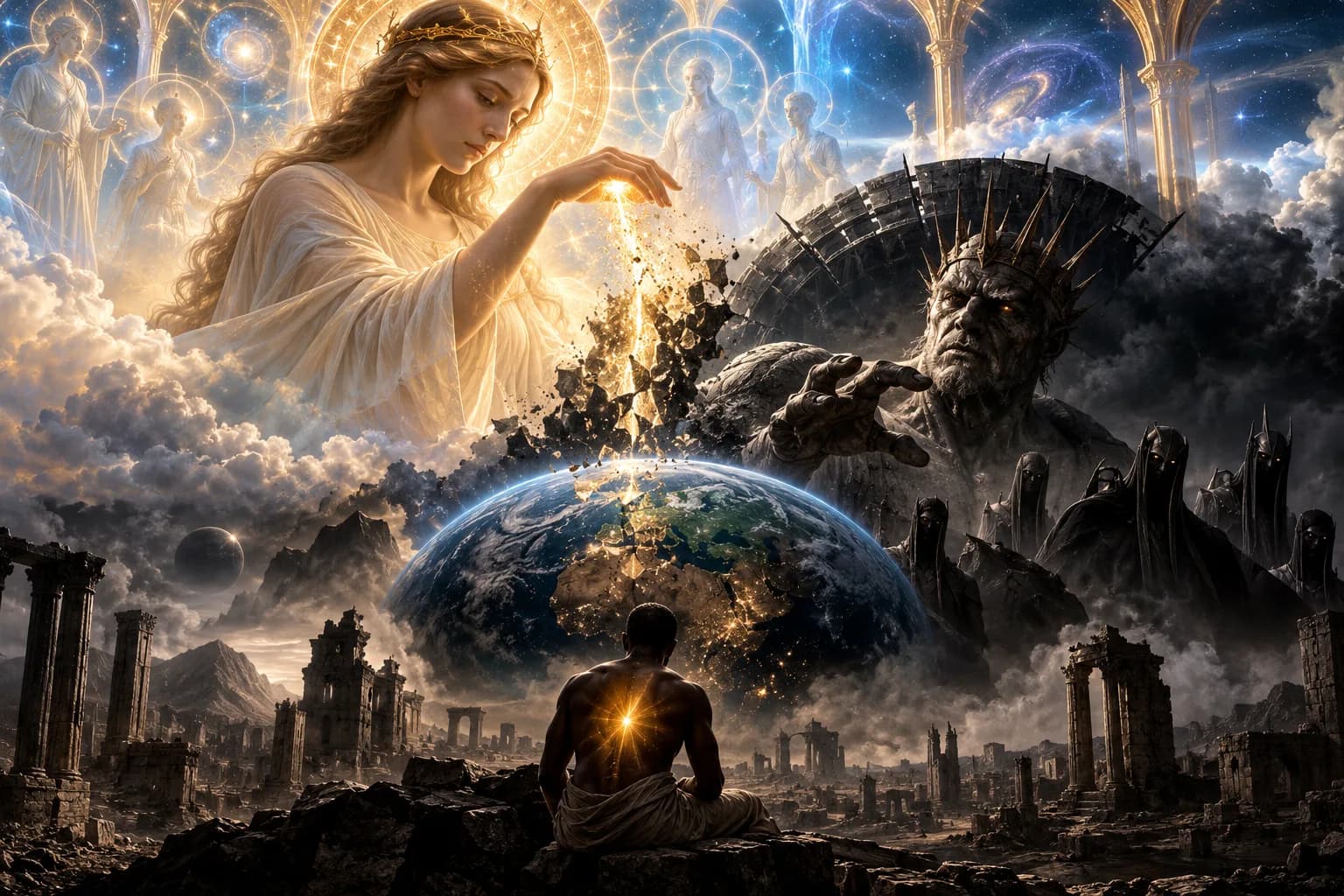
To modern ears, the suggestion that the world came about through a mistake sounds extraordinary. We are more familiar with the idea of a universe deliberately created by an all-powerful and all-knowing God. Yet some of the writings associated with ancient Gnostic traditions tell a very different story.
They invite us to consider an unsettling possibility. What if the material world is not a perfect expression of the highest divine reality? What if its imperfections are not simply the result of human wrongdoing, but reflect something much deeper in the story of creation itself?
Questions of this kind lie at the heart of some of the remarkable writings discovered near Nag Hammadi in Egypt in 1945.
A Different Story of Creation
In the Apocryphon of John, the ultimate source of existence is described as the Invisible Spirit, a reality so transcendent that ordinary human categories cannot adequately describe it. It is beyond measurement, form and the limitations through which we normally understand existence.
From this divine source comes a spiritual fullness often called the Pleroma. Within this higher reality are divine beings known as Aeons, among whom Sophia, whose name means Wisdom, plays a decisive role.
The story takes a dramatic turn when Sophia brings forth something without the participation of her consort. What emerges is imperfect and unlike the beings of the divine fullness. This being is commonly known as Yaldabaoth.
Yaldabaoth does not recognise the greater reality from which his own existence ultimately derives. Instead, he believes himself to be supreme. The Apocryphon of John portrays him declaring that he is God and that there is no other God beside him.
Within the Gnostic narrative, however, this is not a declaration of genuine supremacy. It is evidence of ignorance. The creator believes himself to be the highest God precisely because he does not know what exists above him.
This is one of the most striking ideas in Gnostic thought: the creator of the material cosmos does not fully understand his own origin.
The Demiurge and the Material World
The term Demiurge is commonly used for this subordinate creator. The idea of a cosmic craftsman did not originate with the Gnostics. Plato had already described a Demiurge in the Timaeus, although Plato's creator is very different from the ignorant ruler encountered in some Gnostic writings.
Certain Gnostic traditions radically transformed the idea. Their Demiurge is not the ultimate source of existence. He belongs to a lower order of reality and, with the assistance of rulers usually called Archons, becomes associated with the formation and government of the material cosmos.
This produces one of the most challenging reversals in ancient religious thought. The being who exercises authority over the visible world may not be the highest divine being at all.
For readers accustomed to identifying the creator of the world automatically with the supreme God, this distinction can be startling. Yet it is essential to understanding why the Gnostic view of the human condition differs so sharply from more familiar religious accounts.
Was Creation Literally a Mistake?
The word mistake must be used carefully. Gnosticism was never a single, uniform religion with one universally accepted account of creation. The surviving texts contain different cosmologies, symbols and theological ideas, and it would be misleading to force all of them into one system.
Nevertheless, a recurring theme in several of these writings is that the present cosmos is marked by ignorance, deficiency, imitation and separation from a higher divine fullness.
The mistake, then, is not best understood as though someone simply made an error and accidentally produced the universe. It points towards a deeper disruption in the proper order of reality.
Sophia acts outside the harmony of the divine fullness. A lesser being emerges and mistakes himself for the highest God. A material order develops under conditions of ignorance. Humanity eventually finds itself within that order, yet carries something that seems not to belong entirely to it.
It is here that the Gnostic story becomes particularly interesting, because the mythology of the cosmos becomes a story about the human being.
The Divine Spark Within Humanity
For many Gnostic traditions, we are not merely creatures of the material world. There is something within humanity that points beyond it.
This helps explain the extraordinary importance given to Adam in several Gnostic texts. The rulers fashion the human form, but the story does not end with their creation. A higher divine power becomes involved, and the human being comes to possess an element connected with a reality beyond the authority of the rulers themselves.
This creates a profound paradox. Physically, we belong to the world around us. We are born into it, live within it and eventually die within it. Yet the Gnostic myth suggests that something within us has another origin.
That idea lies close to the heart of gnosis.
Gnosis is sometimes described simply as secret knowledge, but that description does not go far enough. It is better understood as recognition or awakening. It is the discovery of who we are, where we come from, what has happened to us and what within us belongs to a reality greater than the visible world.
In this sense, salvation is not merely obedience to an external authority. It involves awakening from ignorance.
Why These Ancient Ideas Still Matter
One does not have to accept Gnostic cosmology as a literal description of the universe to understand why these writings continue to fascinate readers nearly two thousand years later.
The questions behind them have never really disappeared.
Why does a world supposedly created by divine goodness contain so much suffering, disorder and injustice? Why do human beings sometimes feel strangely alienated from the societies and systems they themselves have created? Why can material achievement leave deeper questions unanswered? What exactly is consciousness? Why have so many cultures imagined that there is something within the human being that cannot be reduced entirely to the physical body?
The Gnostics offered one of antiquity's most radical responses to these questions.
Perhaps humanity's predicament cannot be explained simply by saying that human beings fell within an originally perfect world. Perhaps, some Gnostic thinkers suggested, disorder reaches much further back into the structure of the cosmos itself.
Whether we approach this as theology, mythology, philosophy or psychological symbolism, the idea remains provocative.
It changes the question from “Why is there evil in God's perfect world?” to something far more unsettling:
“What if perfection belongs to a reality beyond this world?”
Once that possibility is raised, the Gnostic story becomes more than an unusual ancient creation myth. It becomes an invitation to reconsider what we mean by God, creation, consciousness, and humanity's place in existence.
These are some of the questions I explore in my book, The World That Came Through a Mistake: Sophia, the Demiurge, Adam, the Archons, and the Gnostic Mystery of a World in Captivity.
Drawing on ancient sources including the Apocryphon of John, The Hypostasis of the Archons, On the Origin of the World, The Gospel of Philip and The Gospel of Truth, I examine Sophia's role in the Gnostic drama, the emergence of the Demiurge and the Archons, the creation of humanity, the reinterpretation of Eden, the divine spark, death and the possibility of awakening through gnosis.
My purpose is not to tell readers what they must believe. It is to return to the ancient sources, examine what they actually say, and ask why ideas formulated so long ago continue to speak to questions that remain unresolved today.
Dominic C Ndulue