Title: What the Gnostics Meant by the Divine Spark
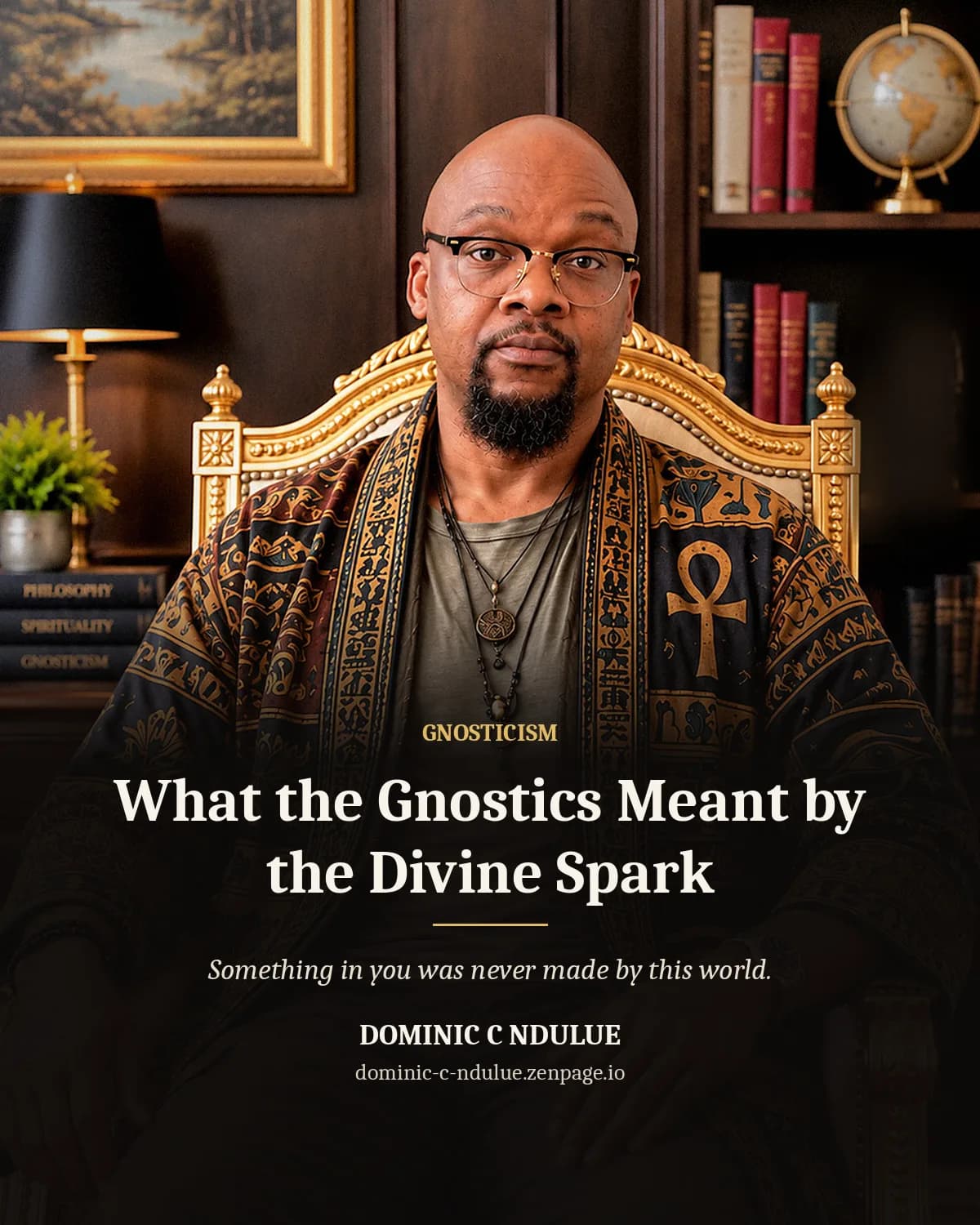
Meta description: The Gnostics taught that something in you was never made by this world. Here is what the divine spark actually means, and why it is not the flattering idea it first appears to be.
There is a particular kind of loneliness that has nothing to do with being alone. You can have people around you, work that occupies you, a life that looks orderly from the outside, and still carry the sense that something is missing. Not a problem to be solved. A part of you that is somewhere else.
The ancient Gnostics had a name for what that feeling points to. They called it the spark.
A claim, not a compliment
The Gnostic texts speak of it in several ways: the seed, the light, the inner man. Different names, one claim. Beneath your body, your temperament, your conditioning and every role you have been handed, something remains that did not begin here.
It sounds like a flattering idea, and it usually gets read as one. That is why it turns up on posters and in slogans about your inner light. But look carefully at what the claim actually says, and it becomes stranger and more demanding than the comfortable version.
First, notice what it does not say. The spark is not a reward. It is not the result of discipline or virtue. You did not earn it, develop it, or choose it. It was there before any of that, which means it cannot be increased by good behaviour or forfeited by bad. That should be unsettling as well as reassuring, because it takes the thing you most want to claim credit for and places it outside your control.
Second, notice what it does say. The powers of this world did not create it. In the Gnostic account, that matters enormously. The world we inhabit is the work of a lesser craftsman, the Demiurge, and it is administered by the Archons: the rulers, the systems, the mechanisms of habit and fear. They can shape almost everything about your life. They cannot make the spark, and they cannot destroy it.
What they can do is obscure it. The texts insist that obscuring it is their main occupation. Not violence. Not persecution. Distraction. Noise. The steady accumulation of roles and obligations that leaves no quiet hour in which a person might ask what is underneath all of it.
Why this is not the same as self-esteem
Modern spirituality often arrives at a similar sounding conclusion by a different route: you are enough, you are worthy, you are divine. The Gnostic claim is not quite that. It does not say you are wonderful. It says that the part of you that matters most is not your achievement, your personality or your reputation, and that most of what you call yourself belongs to this world rather than to you.
That is a harder teaching, because it does not build you up. It relocates you. It suggests that the self you have spent years constructing is not the self that was there first.
How the spark wakes
The spark is usually dormant. In the Gnostic texts it does not wake through effort, ritual or moral improvement. It wakes through recognition, the moment of seeing something you had somehow always known but never stated.
The Greek word is gnosis: knowledge, but of the kind that comes from recognising rather than learning. Not information about God. A recognition of what you already are.
And here the texts are unromantic. Recognition is only the beginning. The work that follows is difficult, unglamorous and never quite finished, because the conditions that obscured the spark in the first place are still there the next morning. The systems still run. The habits still pull. What changes is that you now know what they are obscuring.
Why it still matters
You do not need to accept second-century cosmology to feel the force of this. Strip away the Demiurge and the Archons, and a recognisable question remains: how much of what you take to be yourself was actually given to you by your circumstances, your work, your fears and the expectations of other people? And what, if anything, lies underneath?
The Gnostics answered that something does. They also insisted that it is not obvious, not automatic, and not something anyone else can hand to you.
That is the subject of my second book, The Fractured Self: Recovering Wholeness with Gnostic Wisdom. It traces the fracture at the centre of modern experience, the ancient account of where it comes from, and the path the Gnostics mapped back towards wholeness.
The Fractured Self: Recovering Wholeness with Gnostic Wisdom is available on Amazon from 28 September 2026, in paperback and Kindle.
Also by Dominic C Ndulue: The World That Came Through a Mistake, available now on Amazon.